
Garage Floor Prep and Crack Repair in Vacaville
Epoxy Floors Bench Vacaville covers garage floor prep in Vacaville — diamond grinding, crack and spall repair and moisture testing — the work that decides whether a coating bonds, and how a slab a few years old differs from one poured in the 1960s or 1970s.
Bookings aren't open yet. Leave your name and number; your message is recorded, and you'll get one message when a local installer is available.
 Illustration
Grinding versus etching, and what each leaves behind
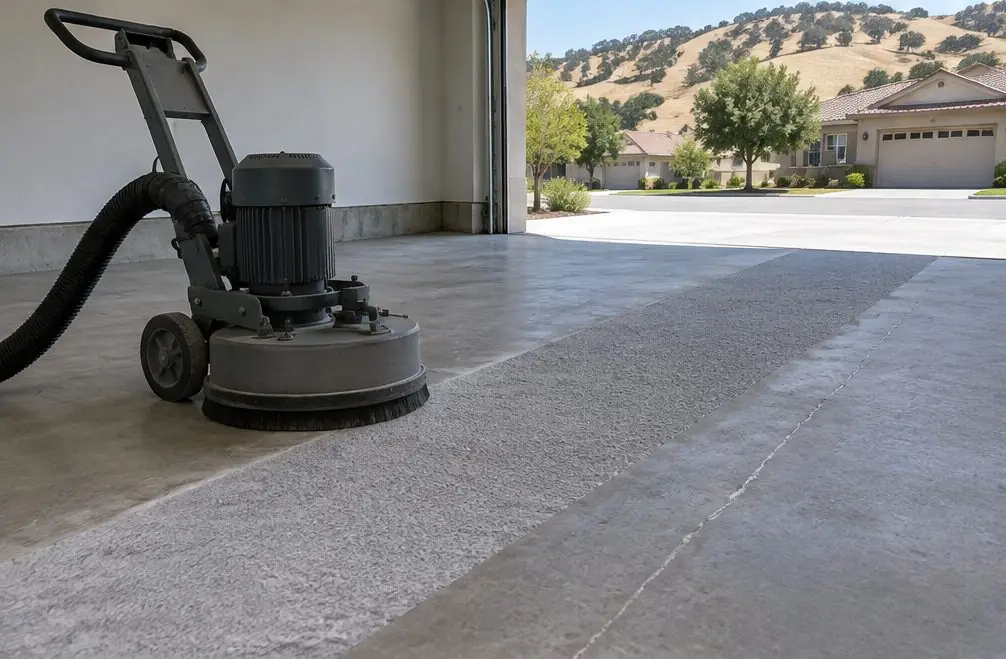
A coating holds on texture. Diamond grinding scratches the concrete to a roughness that coating pros describe with a concrete surface profile (CSP) number; acid etching dissolves the surface lightly and leaves a milder, less even profile.
| Diamond grinding | Acid etching | |
|---|---|---|
| Action | Removes the weak top layer and opens the pores | Dissolves a thin film of cement paste |
| Profile | Deeper and even | Light and patchy |
| Dust and mess | Captured by a shroud and vacuum | Wet slurry to rinse and neutralize |
| Old paint | Takes it off | Cannot |
| Afterwards | Slab is dry, ready to coat | Must dry completely |
Diamond grinding opens the surface so the coating can bond; acid etching is a weaker substitute.
What the numbers show
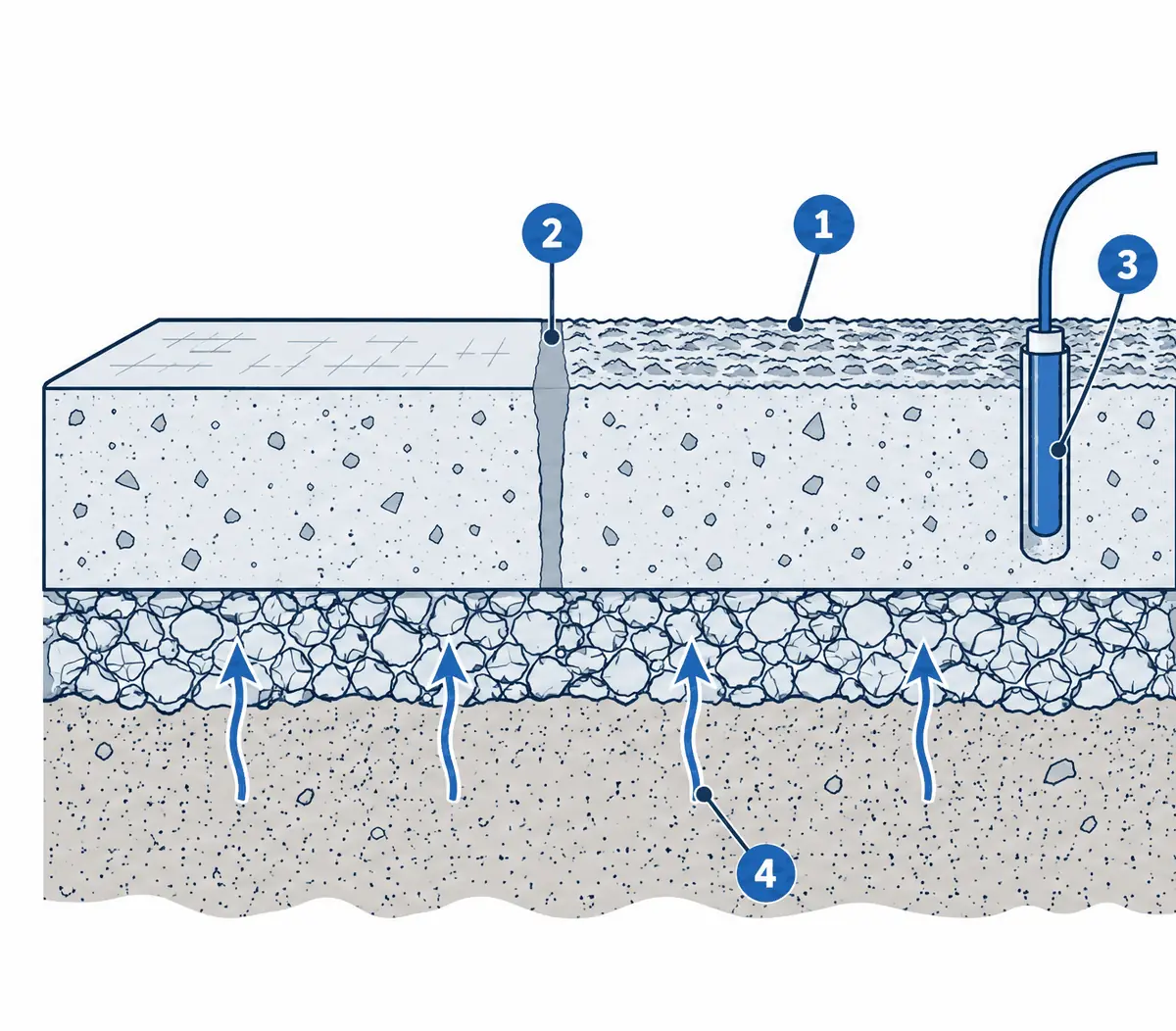
- Ground surface Diamond grinding leaves a deeper, even profile than acid etching, which leaves a light, uneven one, and it removes old paint that etching cannot.
- Filled crack A crack is cut open, filled and ground flush with the surface; a moving crack can show again through the coating.
- In-slab humidity probe In the ASTM F2170 test, a sensor sits in a drilled hole inside the slab and reads the relative humidity there.
- Vapor from below Moisture vapor can rise through the slab from the ground, especially where there is no vapor barrier; a calcium chloride test (ASTM F1869) measures what leaves the surface.
Sorting cracks by type
| Crack | How it looks | Usual repair | What to expect |
|---|---|---|---|
| Hairline shrinkage | Fine, short, sometimes star-shaped | Routed or filled, ground flush | Usually stays closed |
| Control joint | Straight sawn line between slab panels | Flexible joint filler | Moves a little with temperature; the fill flexes |
| Settlement | One edge sits lower than the other | Leveled with repair mortar | Ask whether the movement has stopped |
| Widening crack | Grows or steps over months | Look from a concrete or foundation professional | May show again through a coating |
Cracks are filled and ground flush; a moving crack can show again. Repair of minor cracks, pits and spalls typically adds $1–$2 per square foot, or about $50–$200 for each extra repair area.
New-tract slabs and 1960s slabs
Housing in Vacaville is a mix. Third-party estimates for ZIP 95687 put roughly 54% of homes at 2000 or later and roughly 26% in the 1960s and 1970s, and large new tracts such as The Farm at Alamo Creek, given the go-ahead by the City Council in 2018 with 562 single-family homes and 184 duets, keep adding young slabs.
- A slab a few years old can still be releasing water; confirm how long it has cured and test moisture before anything goes down.
- A 1980s or 1990s tract garage often has shrinkage cracks, oil under the car and sometimes old paint.
- A 1960s or 1970s garage may have patches, no vapor barrier and, under old paint or tile, materials that should be tested before grinding.
The valley's 37-degree July day-night swing also makes concrete expand and contract through the day, which is one reason hairline cracks open at control joints.
Three moisture checks, cheap to exact
A slab with moisture vapor coming up through it can push a coating off. Three tests are in common use:
- Plastic sheet test. A taped square of plastic left for about a day; condensation underneath hints at moisture. Cheap and qualitative.
- Calcium chloride test, ASTM F1869. Measures moisture vapor emission over 60 to 72 hours, in pounds per 1,000 sq ft per 24 hours.
- In-slab humidity probes, ASTM F2170. Probes set into drilled holes read the relative humidity inside the slab.
Many installers test before coating, and where readings are high, a moisture-mitigating primer is used or the job is reconsidered. The vapor-barrier primer is a priced option in the calculator, about $400–$1,000 for a typical garage.
Where prep money goes
Grinding is built into every system price. What moves the total is the condition of the slab.
| Slab condition | Added to the system price |
|---|---|
| Sound slab | $0 |
| Minor cracks, pits or spalls | $1–$2 per sq ft |
| Old coating or paint to remove | $2–$6 per sq ft |
| Heavy oil or a soft slab | $1–$2.50 per sq ft |
For a 420 square foot garage, minor cracks add about $420–$840 to the system price. These are market estimates, not quotes.
Garage Floor Prep and Crack Repair — common questions
Is acid etching enough to prepare a garage floor?
It is a weaker substitute for diamond grinding. Etching leaves a light, uneven profile and cannot remove old paint, so grinding is the usual standard for a professional job.
Does a hairline crack mean a foundation problem?
Usually not; shrinkage cracks from curing are the commonest kind. A crack that widens or leaves one side higher than the other is worth a look from a concrete or foundation professional.
Does a brand-new garage slab need a moisture test?
A new slab still holds water from the pour, so testing it is more important, not less. The data sheet of the coating names the readings it tolerates.
Garage Floor Prep and Crack Repair: check availability and price range
Bookings aren't open yet — a typical Vacaville range in about 30 seconds.