
Polyaspartic Garage Floor in Vacaville
Epoxy Floors Bench Vacaville covers polyaspartic and polyurea garage floors in Vacaville — thin, fast-curing and generally UV-stable coatings, what the one-day label actually covers, and why a valley afternoon makes the mixing window the thing to plan around.
Bookings aren't open yet. Leave your name and number; your message is recorded, and you'll get one message when a local installer is available.
 Illustration
Reading the one-day label
Many polyaspartic systems can be installed in one day. Foot traffic usually resumes the next day, and vehicles return after the time on the product's data sheet, often 24 hours to several days depending on the product, temperature and humidity. Epoxy systems usually take longer, often several days before a car.
The label describes the crew's schedule, not the moment the floor is ready for everything. The speed comes from a fast chemical reaction, which lets primer, base, chips and clear coat go down in a single visit instead of across several days of waiting.
Cure and return-to-service steps
| Step | Typical wait | What sets it |
|---|---|---|
| Walking in clean soft shoes | Often the next morning | Product and slab temperature |
| Light use, carrying items back | Per the data sheet, often one to a few days | Humidity, film thickness |
| Parking a vehicle | Per the data sheet, often 24 hours to several days | Tire heat, ventilation |
| Cleaners and chemicals | Per the data sheet | Cure schedule of that product |
Mixing on a 97°F afternoon
Polyaspartic has a short working time, and heat shortens it further. Vacaville's July mean high is 97.3°F, and by mid-morning a garage slab can already be warm. Installers mix smaller batches, work from the far wall toward the door and begin at first light, when the slab is closest to its overnight 60°F. A shaded, ventilated garage gives more room than one with the door facing the afternoon sun.
A slab that is warm in the afternoon and cool at dawn affects working time and outgassing; installers check slab temperature and dew point. Some systems have a strong odor while they cure; the garage is ventilated, and people and pets stay out until the product's data sheet says otherwise.
Full polyaspartic, hybrid or polyurea over epoxy
| Build | Base coat | Top coat | Trade-off |
|---|---|---|---|
| Full polyaspartic | Polyaspartic | Polyaspartic | Quickest; higher material cost; very short mixing window |
| Hybrid | Epoxy | Polyaspartic | Longer working time below, UV-stable surface above |
| Polyurea over epoxy | Epoxy | Aliphatic polyurea | Flexible film that relies on a clean bond to the base |
Polyaspartic and polyurea top coats are generally more UV-stable than standard epoxy and cure faster; epoxy is often used as a base coat because it has a longer working time and bonds well to a ground slab. For a newer tract-home slab that is only a few years old and has not been moisture tested, a hybrid is a common middle path.
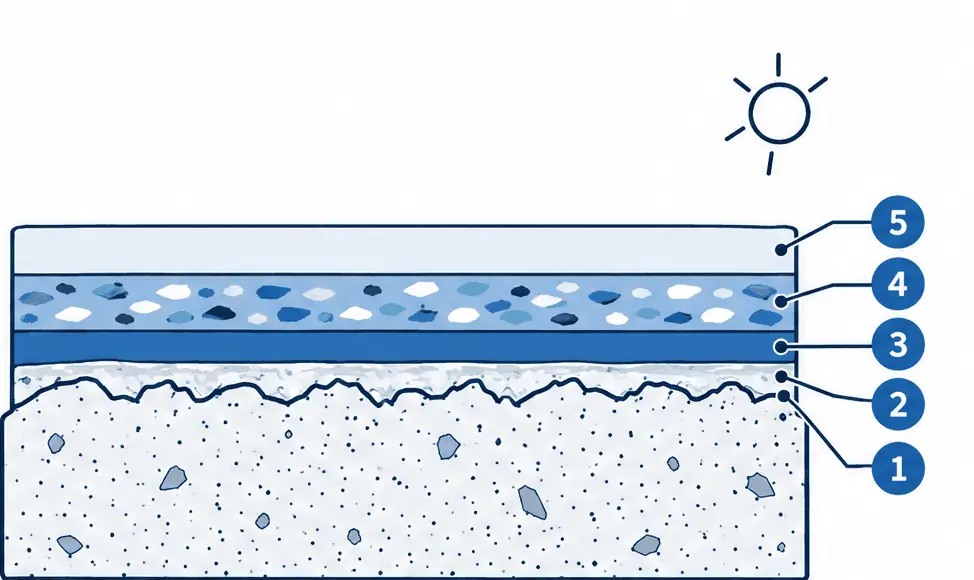
What the numbers show
- Ground concrete The same rough ground profile as any system; polyaspartic is less forgiving of a damp or poorly ground slab.
- Penetrating primer Seals the slab before the quick layers go on; a vapor-barrier primer goes here if a moisture test calls for one.
- Thin pigmented base Polyaspartic, or epoxy in a hybrid. It is applied in small batches because the mixing window is short, shorter still on a hot afternoon.
- Chips in the base Thrown into the wet base the same way as on an epoxy floor.
- Polyaspartic clear coat The UV-stable top layer; polyaspartic and polyurea top coats are generally more UV-stable than standard epoxy and cure faster.
Polyaspartic prices for Vacaville garages
A polyaspartic flake system runs about $7–$11 per square foot on a sound slab in 2026.
| Garage | Area | Polyaspartic flake, sound slab |
|---|---|---|
| 1-car | about 240 sq ft | $1,680–$2,640 |
| 2-car | about 420 sq ft | $2,940–$4,620 |
| 3-car | about 704 sq ft | $4,928–$7,744 |
Moisture is the usual surprise: a slab that tests high may need a vapor-barrier primer, about $400–$1,000 for a typical garage, and polyaspartic is less forgiving of a damp slab than a patient epoxy base. These are market estimates, not quotes.
Polyaspartic Garage Floor — common questions
Is polyaspartic better than epoxy for a garage?
Polyaspartic and polyurea top coats are generally more UV-stable than standard epoxy and cure faster, while epoxy is often the base because it has a longer working time. Strength depends on film thickness, prep and the product, so compare data sheets rather than slogans.
Does a polyaspartic floor smell while it cures?
Some systems have a strong odor while they cure. The garage is ventilated, and people and pets stay out until the product's data sheet says otherwise.
Why does the hybrid cost less than full polyaspartic?
The epoxy base is cheaper and gives the installer more working time on a hot day. In Vacaville a hybrid is typically priced between the epoxy and full polyaspartic bands.
Polyaspartic Garage Floor: check availability and price range
Bookings aren't open yet — a typical Vacaville range in about 30 seconds.